Water mitigation is the emergency part of a water damage job: stopping the water, removing what is standing, taking out materials that cannot be saved and drying the rest of the structure before mold gets a foothold. In Florida it is also the part your insurer expects you to start right away, because a homeowners policy puts the duty to protect the property from further damage on you. This guide explains what mitigation includes, how it differs from restoration, what Florida law says about claims and contracts, and how to reach a mitigation provider by phone.
If water is on the floor right now, shut off the main valve if you can do it safely, keep away from wet outlets, then call (844) 206-6708. A partner call service checks whether a participating water mitigation company serves your Florida address, and we may be paid when you call. Prefer to write? You can also send a request through our contact page.
What water mitigation covers, and what it does not
Restoration companies usually split a water loss into two phases. Mitigation is everything done to stop the damage from growing. Restoration, sometimes called reconstruction or rebuild, is putting the house back the way it was. The same company can do both, but they are often priced, documented and paid separately, so it helps to know where the line sits.
A typical mitigation scope includes:
- Source control: confirming the water is off and the leak, overflow or roof opening is stopped or covered. The repair of the pipe or roof itself is plumbing or roofing work.
- Water extraction: pumping and vacuuming standing water from floors and carpet.
- Removal of what cannot be dried: wet carpet pad, swollen baseboards, the lower section of soaked drywall, insulation and, depending on the water category, contents that cannot be cleaned.
- Structural drying: air movers and dehumidifiers set up to pull moisture out of the framing, slab and walls, with readings taken until the materials reach a dry standard.
- Documentation: photos, moisture readings and a written list of what was removed, which your adjuster will want to see.
What mitigation usually does not include: new drywall, paint, flooring, cabinets and trim. Those belong to the rebuild. Our guide to what drying equipment actually does explains why a room can still feel damp while the equipment is running.
Why the first 24 to 48 hours decide so much
The U.S. Environmental Protection Agency is direct about timing: “It is important to dry water-damaged areas and items within 24-48 hours to prevent mold growth.” The same guide adds that if wet materials are dried within that window, in most cases mold will not grow (EPA, A Brief Guide to Mold, Moisture and Your Home, updated February 18, 2026). In a Florida house, where outdoor air is humid much of the year, that window is the main reason mitigation is treated as an emergency rather than a project you schedule next week.
The EPA also recommends keeping indoor humidity below 60 percent, ideally between 30 and 50 percent. Drying equipment is how a mitigation crew brings a wet structure back into that range.
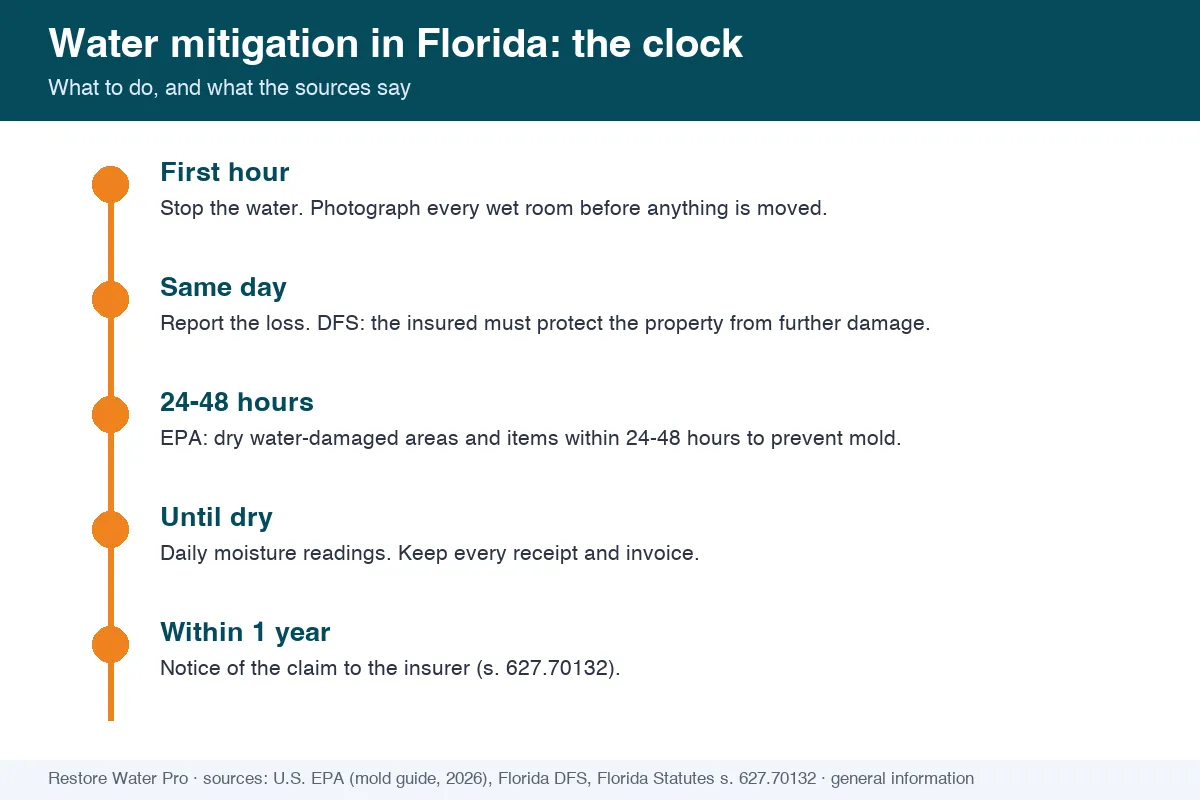
| When | What to do | Why it matters |
|---|---|---|
| First hour | Stop the water, keep clear of wet electrical items, photograph every wet room before anything is moved | Photos taken before cleanup are the evidence your claim is built on |
| Same day | Report the loss to your insurer; call a mitigation provider for extraction and drying | Florida DFS says the insured has a responsibility to protect the property from further damage |
| Within 24-48 hours | Wet materials removed or drying equipment running, moisture readings recorded | EPA: dried within this window, in most cases mold will not grow |
| Daily until dry | Ask for the readings, keep every invoice and receipt | Receipts for emergency repairs are part of what DFS tells homeowners to keep |
| Within 1 year of the loss | Make sure notice of the claim has been given to the insurer | Florida Statutes s. 627.70132 bars claims noticed later |
What Florida law and your insurer expect from you
The Florida Department of Financial Services (DFS) puts it plainly in its homeowners insurance overview: “The insured has a responsibility to mitigate damages to their property and protect the property from further damage,” and should “make reasonable temporary repairs and keep accurate records and receipts of those repairs” (Florida DFS, Homeowners Insurance Overview). The DFS Homeowner Claims Bill of Rights says the same thing in checklist form: make and document emergency repairs needed to prevent further damage, keep the damaged property if feasible, keep all receipts, and take photographs before and after any repairs.
Three Florida rules are worth knowing before you sign anything:
- The notice deadline. Under Florida Statutes s. 627.70132, a new or reopened property claim is barred unless notice was given to the insurer within 1 year after the date of loss; a supplemental claim must be noticed within 18 months. Our article on the Florida water damage claim deadline covers this in more detail.
- No assignment of benefits on newer policies. Under s. 627.7152(13), a policyholder may not assign post-loss benefits under a residential property policy issued on or after January 1, 2023, and an attempt to do so is void. In practice, the mitigation contract is between you and the company, and you remain the one dealing with your insurer.
- Licensing. The DFS bill of rights tells homeowners to confirm that the contractor they choose is licensed to do business in Florida. Mold remediation is a licensed activity in Florida when it covers more than 10 square feet (s. 468.8411); our article on the Florida mold remediator license explains what that means. Plumbing and roofing repairs are done by licensed contractors you can look up on the DBPR license search.
Questions about a claim can go to the DFS consumer helpline at 1-877-693-5236. Our guide on filing a water damage insurance claim in Florida walks through the paperwork.
Mitigation vs. restoration at a glance
| Mitigation | Restoration / rebuild | |
|---|---|---|
| Goal | Stop the damage from spreading | Return the home to its pre-loss condition |
| Timing | Hours to days after the loss | After the structure is dry and the claim scope is agreed |
| Typical work | Extraction, tear-out of wet materials, drying, moisture readings | Drywall, paint, flooring, cabinets, trim |
| Paperwork | Photos, drying logs, list of removed items | Written estimate compared with the adjuster’s scope |
Because mitigation happens before the adjuster has seen everything, the drying logs and photos are what show that the work was necessary. Ask for copies as the job goes, not at the end.
Questions to ask a Florida mitigation company on the phone
- Can you come out today, and what will you do on the first visit?
- Will you photograph and take moisture readings before removing anything?
- Which materials do you expect to remove, and will you show me why?
- Will I get daily drying readings and a written list of what was removed?
- Is the rebuild a separate estimate, and can I choose a different contractor for it?
- Who holds the mold remediation license if mold is found over 10 square feet?
Our list of questions to ask a restoration company goes further, and the page on the clean, gray and black water categories explains why the source of the water changes what can be saved.
Water spreading under cabinets or into a second room? Call (844) 206-6708 to check which participating mitigation providers serve your area. A partner call service answers and we may be paid when you call; you decide whether to hire anyone.
Where readers are calling from
Most searches that reach this site about water mitigation come from the Treasure Coast, Southwest Florida and North Central Florida. City pages have local contacts and details: Fort Myers, Port St. Lucie, Daytona Beach, Gainesville and Ocala.
Frequently asked questions
Is water mitigation the same as water damage restoration?
No. Mitigation is the emergency work to stop and dry the damage: extraction, removal of wet materials and drying. Restoration is the rebuild afterward. Many companies offer both, but they are usually separate scopes.
Do I have to wait for the adjuster before drying starts?
Florida DFS says the insured has a responsibility to protect the property from further damage and should make reasonable temporary repairs. Report the loss, photograph everything, keep receipts, and ask your insurer how it wants emergency work documented.
How fast does a wet house need to be dried?
The EPA says to dry water-damaged areas and items within 24-48 hours to prevent mold growth.
Can I sign my insurance benefits over to the mitigation company?
Not on a residential property policy issued on or after January 1, 2023. Florida Statutes s. 627.7152(13) makes such an assignment void. Older policies may differ; read your policy and ask your insurer.
How long do I have to report a water damage claim in Florida?
Under s. 627.70132, notice of a new or reopened claim must be given within 1 year after the date of loss, and a supplemental claim within 18 months.
Sources consulted November 13, 2026: U.S. EPA, A Brief Guide to Mold, Moisture and Your Home (updated February 18, 2026); Florida DFS, Homeowners Insurance Overview and Homeowner Claims Bill of Rights (myfloridacfo.com); Florida Statutes s. 627.70132, s. 627.7152 and s. 468.8411 (leg.state.fl.us); Florida DBPR license search. General information, not legal or insurance advice.
Checking what is available in your area
restorewaterpro.com is a connection service. We do not perform restoration, mitigation or plumbing work, and we do not employ technicians. If water has reached floors, walls or cabinets in a Florida home and you want to be matched with participating providers, call (844) 206-6708; a partner call service answers, and we may be paid when you call. Service-area matching applies, availability varies, homeowners only, and you decide whether to move forward.