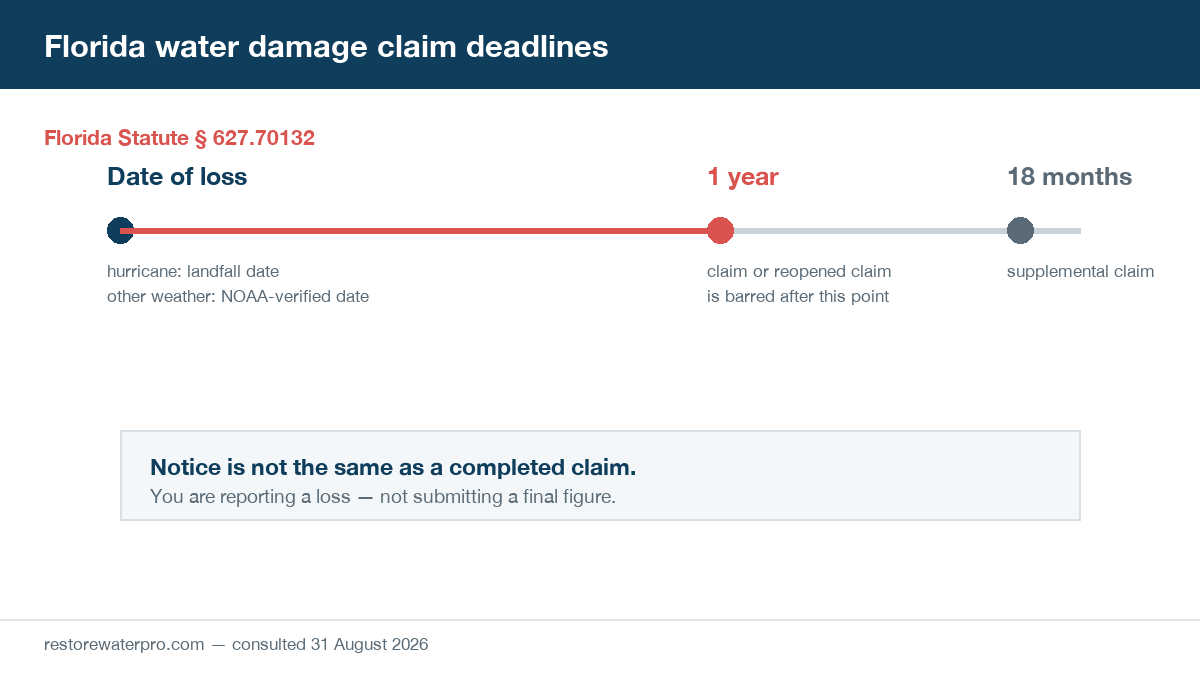
In Florida you have one year from the date of loss to give your insurer notice of a water damage claim. If you are reopening a claim, the same one-year limit applies. For a supplemental claim — additional damage found after the original claim was settled — the limit is eighteen months.
Those deadlines come from Florida Statute § 627.70132. They are not negotiable with an adjuster, and missing them bars the claim regardless of how valid the damage is.
What the statute actually says
The operative wording is that a claim or reopened claim under a property insurance policy “is barred unless notice of the claim was given to the insurer in accordance with the terms of the policy within 1 year after the date of loss.”
Two words in that sentence carry most of the weight.
“Barred” means the claim is finished, not delayed. There is no discretionary extension for a homeowner who was dealing with a contractor, waiting on a second opinion, or simply did not realise how bad the damage was.
“Notice” is the trigger, and notice is a low bar — you are telling the insurer that a loss occurred. You are not required to have a complete estimate, a contractor’s scope, or a final figure before you give it.
When the clock starts, and why weather events are different
For most water damage, the date of loss is the date the damage happened: the day the supply line failed, the day the water heater let go.
Weather is handled differently. Under the same statute, for a hurricane the date of loss is the date the hurricane made landfall; for a tornado, windstorm, severe rain or other weather-related event, it is the date the event is verified by the National Oceanic and Atmospheric Administration.
That distinction matters in practice. If a storm system sat over your area for three days and you noticed the ceiling stain a week later, your clock did not start when you noticed it. It started at the NOAA-verified event date, which may be earlier than you assume.
Notice is not the same as a finished claim
The most common and most costly misunderstanding is treating the one-year deadline as the time you have to complete a claim. It is not. It is the time you have to report one.
The practical consequence: if you are within the year and still arguing with a contractor about scope, waiting for a mould assessment, or unsure whether the damage is worth claiming — give notice anyway. Filing notice preserves your right. Deciding later not to pursue it costs you nothing.
Why waiting hurts you twice
The legal deadline is the slower of the two clocks running against you.
The faster one is physical. Water damage does not hold still while you decide. Materials absorb, wick and stay wet; the mould growth timeline starts within days, not weeks. A delayed claim tends to arrive with worse damage and with a harder job proving what the original event caused versus what months of standing moisture caused afterwards.
Insurers do draw that distinction, and it usually runs against the homeowner. Damage attributed to a lack of maintenance or a failure to mitigate is a common ground for reduction.
What to do in the first week
- Give notice. A phone call or portal submission is enough to start the file. Note the date, the time, and the reference number you are given.
- Photograph before anything is moved or dried. Wide shots for context, close shots for detail, and something in frame for scale.
- Mitigate, and keep the receipts. Policies require you to take reasonable steps to prevent further damage. Extraction and drying are exactly that, and the cost is usually recoverable.
- Keep the damaged materials where it is safe to do so, or photograph them thoroughly before disposal. Removed drywall and flooring are evidence.
- Write down the sequence. When it started, when you found it, what you did and when. Memory degrades and adjusters ask.
Our page on water damage insurance claims covers the documentation side in more detail, and whether insurance covers water damage explains which causes are typically covered in the first place.
The distinction that decides most claims
Coverage usually turns on whether the water event was sudden and accidental, or gradual.
A pipe that bursts is sudden. A seal that has been weeping behind a shower for two years is gradual, and gradual damage is excluded under most policies. This is also why water damage and flood damage are not interchangeable terms: flood, in the insurance sense, generally requires separate coverage entirely.
None of that changes the notice deadline. Report first, argue coverage second.
Questions homeowners ask
I found damage eleven months after the storm. Is it too late?
No — but you have very little room. Give notice today rather than after you have obtained an estimate.
Does calling my agent count as notice?
Give notice in the way your policy specifies, and keep proof of it. The statute says notice must be given “in accordance with the terms of the policy.”
What is a supplemental claim exactly?
It is a claim for additional damage from the same event, made after the original claim was paid or closed. That one carries the eighteen-month limit.
Can the insurer shorten the deadline?
The statute sets the outer limit; your policy may require prompt notice as a condition of coverage. Prompt in practice means as soon as you reasonably can, not eleven months later.
Get the damage documented before the clock runs
Documentation done in the first days is worth more than documentation assembled months later, and a mitigation invoice is one of the strongest pieces of evidence a file can contain.
Request Help — water damage response across Florida, available around the clock.
Sources: Florida Statute § 627.70132, consulted 31 August 2026. This page explains statutory deadlines in general terms and is not legal advice; policy wording varies and your own policy governs. Written by the RestoreWaterPro editorial team.
Leave a Reply