Author: sitenova_admin

  • GRU Water Leak Alert in Gainesville: What to Do Next

    An automated call from Gainesville Regional Utilities saying your meter shows a possible leak is easy to dismiss. It should not be. GRU’s smart meters flag continuous water use, and continuous use in a house usually means water is going somewhere it should not: into an irrigation zone, down a running toilet, or into a wall, a slab or a cabinet base where nobody sees it yet. This guide covers what the alert actually means, how to confirm it at the meter, who is responsible for which part of the pipe, how GRU’s leak adjustment works, and when the leak has become a water damage problem rather than a billing one.

    What the GRU leak alert means, and what it does not

    According to GRU’s Water Leak Detections & Notifications page, the utility reviews smart meter data for unusual patterns, usually continuous use or a sudden, significant increase, and contacts residential customers with an automated phone call when a leak is suspected. The same page is careful about the limits:

    • the alert means you may have a leak, not that you definitely do;
    • GRU cannot tell you where the leak is;
    • if the pattern continues, GRU may call again;
    • water that passes through the meter is billable whether it was used or lost.

    GRU lists the common culprits as a running toilet, a leaking flapper valve, a dripping faucet, a water softener malfunction, and irrigation system damage or stuck valves. Those are mostly nuisances. The ones that damage a house are the ones you cannot see: a supply line behind a vanity, a pipe under a slab, a water heater connection in a closet.

    Confirm it at the meter in about 15 minutes

    GRU’s notification page describes a simple meter check:

    1. Turn off all water inside and outside the home, including irrigation.
    2. Wait 10 to 15 minutes.
    3. Look at the leak indicator on the meter. If it keeps moving, there is a leak on your property.

    GRU’s Leak Detection page adds that its meters read to tenths of a gallon, and gives its own example: movement of one-tenth of a gallon every five minutes works out to 868 gallons a month. For toilets, GRU suggests a dye test: a few drops of food coloring in the tank, no flushing, and a check of the bowl after about 30 minutes. The U.S. EPA’s WaterSense Fix a Leak Week materials describe the same dye method.

    If the indicator moves with every fixture and the irrigation off, the next question is whether the water is leaving the house through a drain or staying in the structure.

    Who is responsible for which section of pipe

    GRU publishes the split on its Responsibility for Damaged Utilities page:

    Service GRU’s responsibility Customer’s responsibility
    Water Everything from the main service outlet up to the water meter The pipe running from the water meter to the house
    Wastewater Damage to lines outside the property line Repairs within the property line

    The leak notification page says the same thing in plainer terms: GRU maintains utility-owned lines and equipment up to the meter, and it does not fix leaks in your home. If water is bubbling up at the meter box or in the street, call GRU at 352-334-3434. If the meter check points to the house side, the repair is yours to arrange, and GRU’s own recommendation is to call a licensed plumber.

    Florida licenses plumbing contractors through the Department of Business and Professional Regulation. Before hiring, you can look up a contractor’s license on the state’s DBPR license search.

    When a leak alert becomes a water damage problem

    A meter alert only tells you water is moving. These signs tell you it is staying in the house:

    • stained or warm spots in flooring, or tile that sounds hollow;
    • baseboards swelling, or paint bubbling low on a wall;
    • a musty smell in a closet or under a sink cabinet;
    • carpet that is damp with no spill to explain it;
    • outside, a patch of grass that stays greener or soggier than the rest, which GRU lists as a warning sign.

    Florida homes add one complication: high indoor humidity and air conditioning condensate can produce damp spots that are not plumbing at all. Our guide to telling condensation from a leak walks through how to separate the two before anything is opened up.

    Timing matters once materials are wet. The EPA’s Brief Guide to Mold, Moisture and Your Home advises drying water-damaged areas and items within 24 to 48 hours to prevent mold growth. A slow leak that has run for weeks has usually passed that window, which is why the repair and the drying are two separate jobs: the plumber stops the water, and drying the cavity, subfloor or cabinet base is what keeps the damage from spreading. Our page on what drying equipment actually does explains why fans alone rarely reach wet materials inside walls.

    The GRU leak adjustment: what to keep

    GRU’s Leak Detection page says that, under limited situations, it may adjust the rate charged for water and/or sewer for a billing period in which you had a leak at your service address. The request goes through GRU’s leak adjustment form and, according to GRU, must be made within 90 days of the billing period in question, with:

    • the type of leak;
    • the date the leak started;
    • the repair date;
    • proof of repair, such as a plumber’s statement or a receipt for repair supplies.

    Two practical points follow. Keep the date of GRU’s alert call, since it helps establish when the leak started. And keep the plumber’s paperwork even if the water damage cleanup is handled by someone else: it is the document GRU asks for. The adjustment is GRU’s decision, and the page does not promise an outcome.

    A short order of operations

    1. Do the meter check with everything off.
    2. If the indicator moves, close the main shut-off at the house and check the obvious fixtures and irrigation.
    3. Look for signs of water in the structure, room by room, and photograph what you find.
    4. Call a plumber for the repair on the house side of the meter; call GRU if the leak is at the meter or beyond it.
    5. If materials are wet, plan the drying the same day. Our checklist for the first 60 minutes of water damage covers what to do before anyone arrives.
    6. File the leak adjustment request within GRU’s 90-day window, with proof of repair.

    Frequently asked questions

    GRU called about a leak, but I can’t find one. What now?

    Run the meter test with all water off. If the indicator does not move, the alert may have reflected a period of continuous use, such as irrigation. If it does move, the leak is on your property, and the absence of visible water often means it is inside a wall, under a slab or underground between the meter and the house.

    Does GRU repair leaks on my side of the meter?

    No. GRU says it maintains utility-owned lines and equipment up to the meter and does not fix leaks in your home. The pipe from the meter to the house is the customer’s responsibility.

    Is the sewer line in my yard my responsibility?

    Per GRU’s responsibility table, wastewater repairs within the property line are the customer’s; damage to lines outside the property line is GRU’s.

    Sources read on October 5, 2026: Gainesville Regional Utilities, Water Leak Detections & Notifications, Leak Detection, and Responsibility for Damaged Utilities; U.S. EPA, WaterSense Fix a Leak Week and A Brief Guide to Mold, Moisture and Your Home; Florida DBPR license search. Utility procedures change; confirm current terms with GRU. General information, not legal advice.

    Checking what is available in your area

    restorewaterpro.com is a connection service. We do not perform restoration or plumbing work, and we do not employ technicians. If a leak has left wet floors, walls or cabinets in a Florida home and you want to be matched with participating providers, call (855) 321-3102 or use the request options on this site. Service-area matching applies, availability varies, homeowners only, and you decide whether to move forward. Gainesville readers can also see our Gainesville water damage page.
  • Does a Florida Mold Remediator Need a State License?

    Florida is one of the states that licenses mold work. That surprises some homeowners, and it surprises others in the opposite direction, because the license does not apply to every patch of mold in a house. Where the line sits, and what the law says about the people on each side of it, is useful to know before you let anyone open a wall.

    The law: Part XVI of Chapter 468

    Mold-related services in Florida are regulated under Part XVI of Chapter 468, Florida Statutes, administered by the Department of Business and Professional Regulation (DBPR). The statute defines two separate professions.

    • Mold assessment is a process performed by a mold assessor that includes physical sampling and detailed evaluation of data from a building history and inspection, to form an initial hypothesis about the origin, identity, location and extent of mold growth of greater than 10 square feet.
    • Mold remediation means the removal, cleaning, sanitizing, demolition or other treatment, including preventive activities, of mold or mold-contaminated matter of greater than 10 square feet that was not purposely grown at that location.

    Both definitions are in section 468.8411 (Florida Statutes, s. 468.8411). The remediation definition carries a further limit: the work may not be work that requires a license under Chapter 489, the construction contracting chapter, unless the person performing it is licensed under that chapter or the work complies with it.

    What the 10 square foot line means

    Both definitions are written around mold growth of greater than 10 square feet. A small area, the kind you might find behind a bathroom vanity or on a window frame, falls below that line as the statute defines these professions.

    The number lines up with federal guidance for homeowners. The U.S. Environmental Protection Agency says that if the moldy area is less than about 10 square feet, roughly a 3 foot by 3 foot patch, in most cases you can handle the job yourself, and that if there has been a lot of water damage or mold covers more than 10 square feet, you should consult its guidance on larger remediation (EPA, A Brief Guide to Mold, Moisture and Your Home). EPA also says that if the damage came from sewage or other contaminated water, you should call in a professional with experience cleaning buildings damaged by contaminated water, whatever the size.

    Measuring is harder than it sounds. What is visible on the face of a wall does not tell you what is on the back of the drywall or inside the cavity, which is one reason an assessment exists as a separate service.

    Who can call themselves a mold remediator

    Under section 468.8414, DBPR licenses applicants it certifies as qualified, which includes passing the licensing examination and documented training in water, mold and respiratory protection. Section 468.8419 then restricts the titles. A person may not use the name or title “certified mold remediator,” “registered mold remediator,” “licensed mold remediator,” “mold remediator,” “professional mold remediator,” or any combination of those, unless the person has complied with Part XVI. The same restriction applies to the parallel titles for mold assessors (Florida Statutes, s. 468.8419).

    That makes the title on a business card or a website something you can check. DBPR’s online license search at myfloridalicense.com is where Florida’s professional licenses are verified. Search by the person’s name or the license number they give you, and confirm the license type and status.

    The rule that separates testing from removal

    The part of Part XVI that most directly protects homeowners is a conflict-of-interest rule in section 468.8419.

    • A mold assessor may not perform or offer to perform mold remediation on a structure for which the assessor or the assessor’s company provided a mold assessment within the last 12 months.
    • A mold remediator may not perform or offer to perform a mold assessment on a structure where the remediator or the remediator’s company provided mold remediation within the last 12 months.
    • An assessor may not accept compensation, inducements or rewards from a remediator for referring business, and may not take on an assessment whose conclusions or fee depend on the outcome.

    The statute carves out one exception to the 12-month rule: a certified contractor classified as a Division I contractor under section 489.105(3). For that case, the statute allows DBPR to require that the contract disclose to the homeowner the right to request competitive bids.

    In practice, if the same company offers to test your house and then quote the removal, ask how it complies with section 468.8419, and whether it holds a Division I contractor certification. A clear answer is a good sign.

    Questions to ask before anyone opens a wall

    • What is your DBPR license number, and is it a mold assessor or a mold remediator license?
    • Did your company assess this structure in the last 12 months?
    • Where is the water coming from, and who is fixing that source?
    • How will you contain the work area, and how will you show that the job is finished?
    • Will the repairs after removal, such as drywall and cabinets, require a separately licensed contractor?

    The moisture question comes first for a reason. EPA’s guidance is blunt that if you clean up mold but do not fix the water problem, the mold problem will most likely come back. In Florida homes, that source is sometimes condensation rather than a leak, which our article on telling condensation from a leak helps sort out. How quickly growth starts after a leak is covered in our mold growth timeline.

    Questions homeowners ask

    Do mold remediators need a license in Florida?

    Yes, for work that falls within the statutory definition of mold remediation, which covers mold growth of greater than 10 square feet. Licensing is handled by DBPR under Part XVI of Chapter 468, Florida Statutes.

    Can I remove a small area of mold myself?

    EPA says that for areas less than about 10 square feet, in most cases you can handle the job yourself, with the exception of damage from sewage or other contaminated water, where it recommends an experienced professional.

    Can the company that tested my home also remove the mold?

    Section 468.8419 bars an assessor from performing remediation on a structure the assessor’s company assessed within the last 12 months, with an exception for certified Division I contractors.

    How do I verify a mold license in Florida?

    Use DBPR’s license search at myfloridalicense.com with the person’s name or license number, and check the license type and its status.

    For more on what the remediation process involves, see our mold remediation page, and our list of questions to ask a restoration company applies to mold work as much as to water.

    Mold remediation is handled separately and is not part of the water damage line. Use the request options on this site.

  • Florida Condo Leak From the Unit Above: Who Repairs What

    Water is coming through your ceiling, and the unit above is not yours. In a Florida condominium, that leak lands on at least three parties at once: you, the owner upstairs, and the association. Each of them is responsible for different parts of the building, and the order in which things happen in the first days decides a lot about how smoothly the repair goes.

    This article is about the repair side: who is allowed to rebuild what, and what to put in writing. It is general information drawn from the Florida Condominium Act, not legal advice. Your declaration of condominium and bylaws are part of the answer, and for a specific dispute an attorney who handles condominium matters is the right person to ask.

    Start with the water, then the paperwork

    The first priority does not change because you live in a condo. Stop the water if you can reach the source, protect what is in the room, and document everything before it is moved. Our guide to the first 60 minutes after water damage walks through that sequence.

    In a condominium, two extra steps belong in that first hour:

    • Get word to the unit above. If no one answers, contact the association or management company so someone with access can shut off water to that unit.
    • Notify the association in writing. A phone call to the manager is useful, but follow it with an email that gives the date, time, where the water appeared and photos. You will want that record later.

    The written notice is not a formality. Section 718.111(11)(j) of the Florida Statutes provides that the association is not obligated to pay for certain property losses that were known, or should have been known, to a unit owner and were not reported to the association until after the association’s own claim for that property was settled or denied as untimely (Florida Statutes, s. 718.111). Prompt notice keeps that question from arising.

    The line the statute draws inside your unit

    Section 718.111(11) separates the building itself from the things inside a unit that serve only that unit. The statute lists items that are the unit owner’s responsibility when they are located within the boundaries of the unit and serve only that unit:

    • floor, wall and ceiling coverings
    • electrical fixtures
    • appliances, water heaters and water filters
    • built-in cabinets and countertops
    • window treatments, including curtains, drapes, blinds and their hardware
    • personal property within the unit or limited common elements

    In a typical ceiling leak, some of what got wet appears on that list, such as wall and ceiling coverings, flooring, cabinets and your belongings, and some of it does not. Where exactly a given item falls depends on the boundaries described in your declaration, which is why the declaration is the first document to pull out.

    The statute adds a related rule in paragraph (n): the association is not obligated to pay for reconstruction or repair of improvements installed by a current or former owner of the unit, or by the developer, if the improvement benefits only that unit and is not part of the standard improvements installed in all units during original construction. Upgraded flooring or custom built-ins are the usual examples homeowners run into.

    Who is allowed to do the rebuilding

    This is the part that surprises people. Section 718.111(11)(g) states that all reconstruction work after a property loss must be undertaken by the association, except as otherwise authorized in that section. A unit owner may undertake reconstruction work on portions of the unit with the prior written consent of the board of administration.

    The board’s consent can come with conditions. The statute allows it to be conditioned on approval of the repair methods, the qualifications of the proposed contractor, or the contract used. And the unit owner must obtain all required governmental permits and approvals before starting reconstruction.

    In practical terms:

    • Before you hire someone to replace drywall, cabinets or flooring, ask the board in writing whether it consents and what conditions it attaches.
    • Ask whether the board needs to see the contractor’s credentials or the contract before work starts.
    • Ask who will pull permits, and keep copies.

    The statute speaks of reconstruction. Emergency steps such as extracting water and setting up drying equipment are a different stage of the job, and waiting on them has real consequences for mold. If you are unsure whether the association treats drying in your unit as something that needs its approval, ask in the same written message and keep the answer. Our explanation of what drying equipment actually does can help you describe that stage clearly.

    When the leak came from the unit above

    The statute does not automatically make the upstairs owner responsible for everything below. Under section 718.111(11)(j), when no event covered by the association’s property coverage is involved, responsibility for reconstruction, repair or replacement follows the maintenance provisions of the declaration or bylaws.

    The same paragraph makes a unit owner responsible for repair or replacement costs not otherwise paid when the damage is caused by intentional conduct, negligence, or failure to comply with the declaration or the association’s rules, by the owner, family members, unit occupants, tenants, guests or invitees. Whether a failed supply line or an overflowing tub meets that description is a factual question, and documentation from the first hour is what it gets decided on.

    One more detail: the statute allows associations, by vote, to opt out of the allocation rules in paragraph (j), and requires a recorded notice when they do. If your association has done so, the declaration as recorded controls. Ask the manager whether any opt-out has been recorded.

    Documents to gather this week

    • Your declaration of condominium, bylaws and current rules.
    • Your written notice to the association and any reply.
    • Dated photos and video from before anything was moved.
    • Moisture readings and a drying log, if a restoration company is involved.
    • Any written consent from the board for reconstruction, with its conditions.

    Ceiling leaks have their own way of spreading along framing before they show, which our page on ceiling water damage explains. When you talk to restoration companies, our list of questions to ask a restoration company is worth having open.

    Questions homeowners ask

    Who repairs the drywall in a Florida condo after a leak from upstairs?

    It depends on the boundaries in your declaration and on what caused the leak. Section 718.111(11) puts wall and ceiling coverings within the unit on the unit owner’s side of the line, and it requires reconstruction after a property loss to be undertaken by the association unless the board gives the unit owner written consent to do it.

    Can I hire my own contractor to rebuild?

    The statute allows it with the prior written consent of the board, which may set conditions on repair methods, contractor qualifications or the contract. You must also obtain the required permits before starting.

    Is the upstairs owner responsible for my damage?

    Not automatically. The statute makes a unit owner responsible for unpaid repair costs when the damage results from intentional conduct, negligence or failure to follow the declaration or rules. Otherwise, the declaration’s maintenance provisions decide.

    Does the association pay for my upgraded flooring?

    Under section 718.111(11)(n), the association is not obligated to pay for repairs to improvements installed by an owner or the developer that benefit only that unit and were not part of the standard improvements in all units.

    If you are dealing with interior standing water or water damage in a Florida home and want to be matched with participating providers, you can use the request options on this site. Service-area matching applies, availability varies, homeowners only, and you decide whether to move forward.

  • Wet Furniture, Photos, and Paperwork: Deciding What to Save

    The water is out and the equipment is running. Now there is a garage full of boxes, a hallway of furniture on foam blocks, and a plastic bin of paperwork that got soaked in the bottom of a closet. Nobody warned you that the hardest part of a water loss is not the building. It is the stuff inside it.

    Contents get handled last and decided in a hurry, usually by an exhausted homeowner standing in a driveway. A little structure helps. Sort by what a material is, not by how much you like it, then treat the small number of genuinely irreplaceable things as their own project.

    Sort by material first

    Restoration decisions for contents follow the same logic as decisions about the building. Hard, non-absorbent things can usually be cleaned and verified. Soft, absorbent things hold water and whatever came with it deep inside, where cleaning cannot reliably reach.

    The EPA states the principle plainly: “absorbent or porous materials, such as ceiling tiles and carpet, may have to be thrown away if they become moldy”, because “mold can grow on or fill in the empty spaces and crevices of porous materials, so the mold may be difficult or impossible to remove completely.” Hard surfaces get the opposite instruction: “scrub mold off hard surfaces with detergent and water, and dry completely.”

    Four rough buckets:

    • Hard and sealed. Glass, ceramics, most metal, solid plastic, sealed hardwood furniture. Usually cleanable.
    • Hard but assembled. Cabinetry, particleboard furniture, wood with veneer. The material may survive while the glue, the core, or the joints do not.
    • Soft and washable. Clothing, bedding, curtains. Often salvageable through laundering, and the water’s category is what decides whether that is a reasonable idea.
    • Soft and unwashable. Mattresses, upholstered furniture with foam, pillows, carpet pad, cardboard, insulation-backed items. This is where losses concentrate.

    What was in the water changes every one of these calls. A clean supply line failure and a drain backup produce different lists, for reasons set out in the guide to how water category decides what can be saved. If the source was a drain or sewer, the contents question is not really a question, and the handling is described under sewage backup cleanup.

    Photographs, documents, and books: the first day matters

    Paper is the one category where a homeowner’s early decisions genuinely change the outcome, because wet paper does two things quickly. It blocks together into a solid mass as it dries, and it becomes a growth surface within days.

    What generally helps in the first hours:

    • Get wet paper out of standing water and away from the wet room entirely, into the driest, coolest space you have with air moving through it.
    • Separate items rather than stacking them. Stand books on end, fanned slightly. Interleave with paper towel and change it as it takes up water.
    • Lay photographs face up on a clean absorbent surface, in a single layer, without letting the image side touch anything it can stick to.
    • Do not try to peel apart photographs that are already stuck together, and do not pull paper that is fused. Both tear.
    • Handle wet paper as little as possible. It has almost no strength when saturated.

    For anything with real value, sentimental or financial, the EPA’s advice is to bring in someone who does this work rather than improvising: the agency suggests consulting specialists such as those in furniture repair, restoration, art restoration and conservation, carpet and rug cleaning, and water damage restoration. Ask them, before you dry anything, whether the materials you have would be better stabilized another way. Some approaches close off later options.

    Going forward, the storage fix is cheap. Ready.gov’s guidance for households in flood-prone areas is to “keep documents in a waterproof container” and to “create password-protected digital copies.” A scan of the deed, the policy declarations page, birth certificates, and titles takes an afternoon once and removes an entire category of loss from every future event.

    Electronics

    The rule that matters is the simple one: do not power on anything that got wet, and do not plug something in to see whether it still works. Corrosion on a live board causes damage that the water alone did not.

    Disconnect it, remove batteries where you can do so safely, and set it somewhere dry with the ports facing down. Then decide whether the device is worth an evaluation by someone who handles water-damaged equipment. For most consumer electronics, the honest answer is that the replacement cost is lower than the recovery cost. The exception is a device holding data you cannot replace, where the goal is not the device at all, it is the drive inside it.

    Furniture, mattresses, and rugs

    Solid wood furniture standing in shallow water for a few hours frequently survives. What fails is the bottom edge of a particleboard case, the glue in an old joint, and anything with a fabric-covered foam core. Foam absorbs, holds, and cannot be verified as clean once contaminated.

    Area rugs are their own conversation. A wool or hand-knotted rug is worth a specialist’s opinion. A synthetic rug with a foam or jute backing that has been sitting in water is usually a straightforward loss, and the backing is why.

    Two practical habits while things are being sorted: get everything off wet flooring and onto blocks or foil pads so furniture legs stop wicking water and staining, and keep unaffected contents out of the wet zone rather than moving them into the garage where the humidity is highest.

    Build the inventory before anything leaves

    The single most common regret after a water loss is discarding items before documenting them. Damaged property is evidence for a claim, and once it is at the curb it is difficult to substantiate.

    • Photograph and video each room before anything is moved, then photograph individual items as they are pulled out.
    • Build a list room by room with a description, approximate age, and what you believe it cost. Approximate is fine; blank is not.
    • Capture model and serial numbers off appliances and electronics before they go.
    • Keep receipts for anything you buy during the event, including bins, fans, and cleaning supplies.
    • Ask your insurer, in writing, whether they want to inspect specific items before disposal, and keep the answer.
    • Ask any company you contact to confirm its licensing and insurance, and to tell you what happens to items taken off site for cleaning.

    How that inventory turns into a settlement, and where the friction usually appears, is covered on the page about filing a water damage insurance claim. If you are still early in the event and the water only stopped moving an hour ago, the sequence in the first 60 minutes after water damage comes before any of this.

    Questions homeowners ask

    Can I wash clothes that were in the water?

    Clothing from a clean-water event usually launders normally. Clothing that sat in drain water or sewage is a different judgment, and the items that cannot take hot water are the ones people most often regret keeping.

    What about items stored in plastic bins?

    Open them. A sealed bin that took on even an inch of water becomes a humid chamber, and the contents can be in worse condition than items that were out in the open air.

    How long can wet contents sit before it stops mattering?

    Less time than people assume. The EPA’s general guidance is that drying damp materials within 24 to 48 hours prevents growth in most cases, and contents in a warm Florida garage are at the unfavorable end of that. Anything porous that has been wet for several days should be assessed rather than assumed fine, and a surface that already smells musty falls under mold remediation rather than cleaning.

    If you are dealing with interior standing water or water damage in a Florida home and want to be matched with participating providers, you can use the request form on this page. Service-area matching applies, availability varies, homeowners only, and you decide whether to move forward.

    Mold remediation is handled separately and is not part of the water damage line. Use the request form on this page.

  • How Long Do You Have to File a Water Damage Claim in Florida?

    How Long Do You Have to File a Water Damage Claim in Florida?

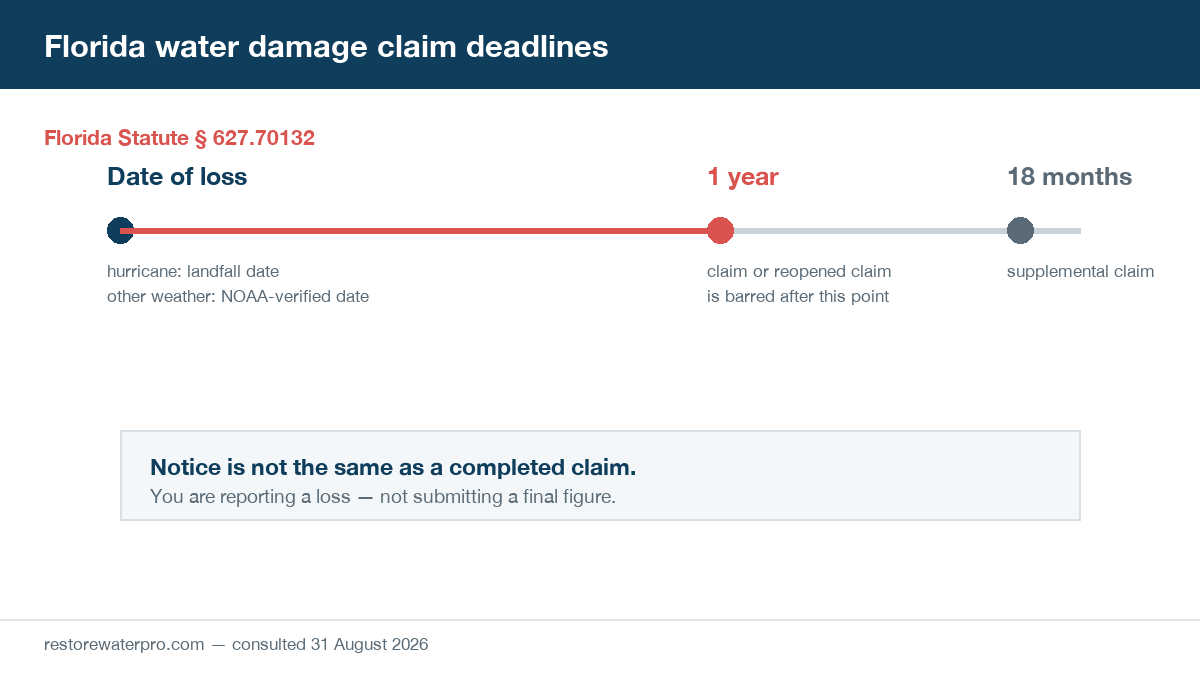
    In Florida you have one year from the date of loss to give your insurer notice of a water damage claim. If you are reopening a claim, the same one-year limit applies. For a supplemental claim — additional damage found after the original claim was settled — the limit is eighteen months.

    Those deadlines come from Florida Statute § 627.70132. They are not negotiable with an adjuster, and missing them bars the claim regardless of how valid the damage is.

    What the statute actually says

    The operative wording is that a claim or reopened claim under a property insurance policy “is barred unless notice of the claim was given to the insurer in accordance with the terms of the policy within 1 year after the date of loss.”

    Two words in that sentence carry most of the weight.

    “Barred” means the claim is finished, not delayed. There is no discretionary extension for a homeowner who was dealing with a contractor, waiting on a second opinion, or simply did not realise how bad the damage was.

    “Notice” is the trigger, and notice is a low bar — you are telling the insurer that a loss occurred. You are not required to have a complete estimate, a contractor’s scope, or a final figure before you give it.

    When the clock starts, and why weather events are different

    For most water damage, the date of loss is the date the damage happened: the day the supply line failed, the day the water heater let go.

    Weather is handled differently. Under the same statute, for a hurricane the date of loss is the date the hurricane made landfall; for a tornado, windstorm, severe rain or other weather-related event, it is the date the event is verified by the National Oceanic and Atmospheric Administration.

    That distinction matters in practice. If a storm system sat over your area for three days and you noticed the ceiling stain a week later, your clock did not start when you noticed it. It started at the NOAA-verified event date, which may be earlier than you assume.

    Notice is not the same as a finished claim

    The most common and most costly misunderstanding is treating the one-year deadline as the time you have to complete a claim. It is not. It is the time you have to report one.

    The practical consequence: if you are within the year and still arguing with a contractor about scope, waiting for a mould assessment, or unsure whether the damage is worth claiming — give notice anyway. Filing notice preserves your right. Deciding later not to pursue it costs you nothing.

    Why waiting hurts you twice

    The legal deadline is the slower of the two clocks running against you.

    The faster one is physical. Water damage does not hold still while you decide. Materials absorb, wick and stay wet; the mould growth timeline starts within days, not weeks. A delayed claim tends to arrive with worse damage and with a harder job proving what the original event caused versus what months of standing moisture caused afterwards.

    Insurers do draw that distinction, and it usually runs against the homeowner. Damage attributed to a lack of maintenance or a failure to mitigate is a common ground for reduction.

    What to do in the first week

    1. Give notice. A phone call or portal submission is enough to start the file. Note the date, the time, and the reference number you are given.
    2. Photograph before anything is moved or dried. Wide shots for context, close shots for detail, and something in frame for scale.
    3. Mitigate, and keep the receipts. Policies require you to take reasonable steps to prevent further damage. Extraction and drying are exactly that, and the cost is usually recoverable.
    4. Keep the damaged materials where it is safe to do so, or photograph them thoroughly before disposal. Removed drywall and flooring are evidence.
    5. Write down the sequence. When it started, when you found it, what you did and when. Memory degrades and adjusters ask.

    Our page on water damage insurance claims covers the documentation side in more detail, and whether insurance covers water damage explains which causes are typically covered in the first place.

    The distinction that decides most claims

    Coverage usually turns on whether the water event was sudden and accidental, or gradual.

    A pipe that bursts is sudden. A seal that has been weeping behind a shower for two years is gradual, and gradual damage is excluded under most policies. This is also why water damage and flood damage are not interchangeable terms: flood, in the insurance sense, generally requires separate coverage entirely.

    None of that changes the notice deadline. Report first, argue coverage second.

    Questions homeowners ask

    I found damage eleven months after the storm. Is it too late?
    No — but you have very little room. Give notice today rather than after you have obtained an estimate.

    Does calling my agent count as notice?
    Give notice in the way your policy specifies, and keep proof of it. The statute says notice must be given “in accordance with the terms of the policy.”

    What is a supplemental claim exactly?
    It is a claim for additional damage from the same event, made after the original claim was paid or closed. That one carries the eighteen-month limit.

    Can the insurer shorten the deadline?
    The statute sets the outer limit; your policy may require prompt notice as a condition of coverage. Prompt in practice means as soon as you reasonably can, not eleven months later.

    Get the damage documented before the clock runs

    Documentation done in the first days is worth more than documentation assembled months later, and a mitigation invoice is one of the strongest pieces of evidence a file can contain.

    Request Help — water damage response across Florida, available around the clock.


    Sources: Florida Statute § 627.70132, consulted 31 August 2026. This page explains statutory deadlines in general terms and is not legal advice; policy wording varies and your own policy governs. Written by the RestoreWaterPro editorial team.

  • Crawl Space Flooding in Florida: What to Do First

    Crawl Space Flooding in Florida: What to Do First

    If water is standing in your crawl space right now, the priority is not the water — it is the air. A flooded crawl space in Florida rarely drains on its own, and the humidity it pushes into the rooms above starts causing damage long before anyone notices a stain on a ceiling.

    This page covers what to do in the first hours, what makes crawl space water different from water on a slab, and when the job stops being something you can handle with a shop vacuum.

    Does your Florida home even have a crawl space?

    Most Florida houses sit on a concrete slab. Slabs are cheaper here, they handle the state’s high water table with fewer moisture problems, and they resist termites better than a wood floor system suspended over open ground.

    Crawl spaces show up in two situations. The first is age: many homes built before slab construction became standard still have them, and they are more common in North Florida than in the south of the state. The second is elevation — on a flood-zone lot where the finished floor has to sit above base flood elevation, raising the house on piers with a crawl space underneath is often the practical answer.

    If you are not sure which you have, look at the exterior wall where it meets the ground. A vent, an access hatch, or a skirt of lattice or block with openings in it means a crawl space. A wall that runs straight into the ground with no openings usually means slab.

    Why crawl space water behaves differently from slab flooding

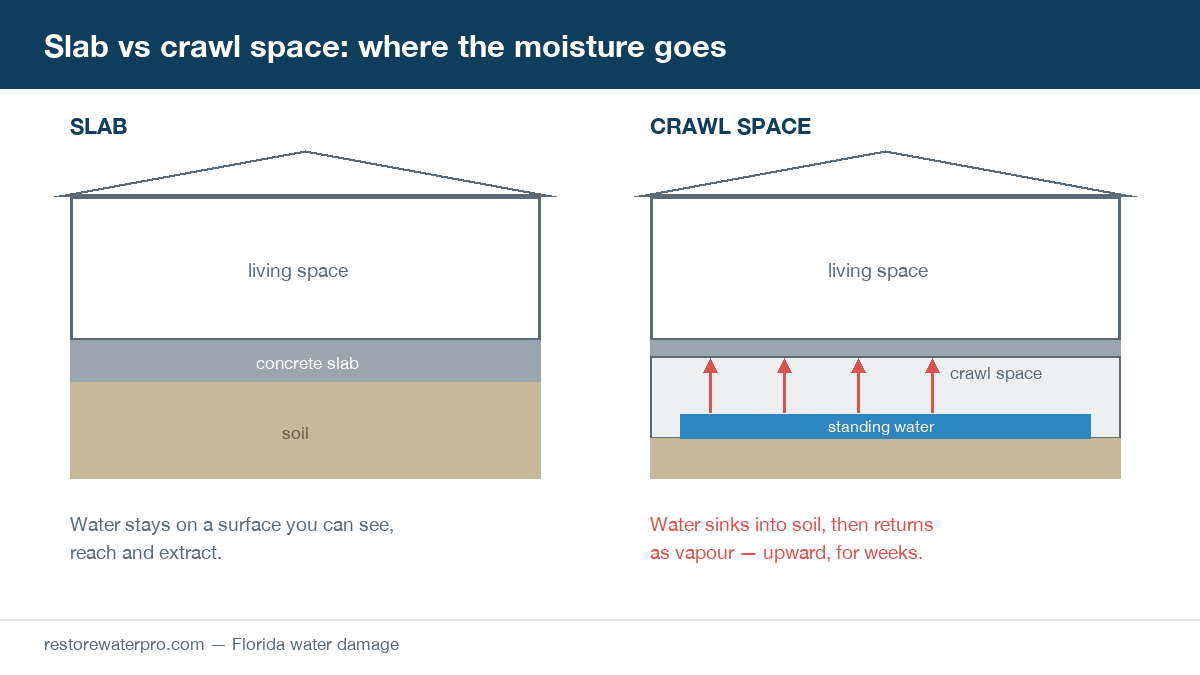
    On a slab, water spreads across a hard surface you can see and reach. You extract it, you dry the flooring, and you deal with wicking into baseboards and drywall.

    A crawl space has none of that. The floor is usually bare soil or a plastic vapour barrier laid over soil. Water that gets in has somewhere to go — down — which makes it look like the problem is solving itself. It is not. The soil holds the moisture and releases it slowly as vapour, and that vapour has only one direction to travel: up, through the subfloor, into the house.

    That is the part homeowners underestimate. The visible water may be gone in a day. The moisture load can stay for weeks, and it is what feeds mould growth in the floor system, insulation, and ductwork.

    The first two hours

    The order matters more than the speed.

    1. Cut the power to the crawl space and to any circuit that runs through it before anyone goes near the opening. Crawl spaces carry wiring, and standing water plus energised cable is the one risk here that can kill.
    2. Find out where the water came from. A supply line under the floor, a failed water heater, groundwater rising through the soil, and sewage backing up are four different problems with four different responses. Guessing wrong wastes the first day.
    3. Do not go in if you cannot identify the source. Confined space, poor light, possible contamination. This is the point where calling someone with the right equipment is cheaper than the alternative.
    4. Open the vents and get air moving only if the outside air is drier than the air underneath. In a Florida August, it very often is not, and running a fan pulls humid air in and makes the drying worse.

    That last point catches people out. Ventilation is not the same as drying. If the outdoor dew point is high, you are importing moisture, not removing it.

    What not to do

    Do not put down fresh plastic sheeting over wet soil. A vapour barrier laid on saturated ground traps the moisture underneath and gives you a slow-release humidifier under your floor.

    Do not replace insulation until the framing is dry. Wet fibreglass batts held against a wet joist keep it wet. Pull the insulation out, dry the structure, then insulate.

    Do not assume the smell will go once the water does. A musty odour in the rooms above after a crawl space event is usually the floor system telling you it is still wet.

    When the water is not clean

    Water is graded by what is in it, and the grade decides how the job is done. We cover this in more detail in our guide to clean, gray and black water categories, but the short version for a crawl space is this:

    • A supply line break starts clean. Left in contact with soil, it does not stay clean for long.
    • Groundwater rising through the soil is contaminated from the start. It has passed through ground that may carry fertiliser, septic discharge, or animal waste.
    • A sewage backup in a crawl space is a containment and disposal job, not a cleanup. Materials that absorbed it come out.

    If you are dealing with the third category, our page on sewage backup cleanup explains what the process actually involves.

    Drying takes longer down there, and that is normal

    A dried-out crawl space is not one that looks dry. It is one where the moisture content of the wood has come back down to what it was before, and soil that has absorbed water gives it back slowly.

    Equipment matters here in a way it does not on a slab. Air movers alone move humid air around a closed space. What removes water is a dehumidifier sized for the volume, running long enough to pull the moisture out of the soil and the framing. Our explanation of what drying equipment actually does covers why the two are not interchangeable.

    Expect the process to be measured, not guessed. Anyone drying a crawl space properly will be taking moisture readings in the joists and subfloor, not judging by feel.

    Why the clock matters for mould

    Mould does not wait for the structure to be convenient. Warm, wet, still air under a Florida house is close to ideal conditions, and a crawl space provides all three by default. Our page on the mould growth timeline after a water leak sets out the sequence.

    The practical consequence: a crawl space that stays wet for a week is a different and more expensive job than the same crawl space dried in forty-eight hours.

    Questions homeowners ask

    The water drained away by itself. Am I fine?
    Probably not. Water leaving the surface means it went into the soil, not out of the building. The moisture is still under your floor and still evaporating upward.

    Can I just run a fan down there?
    Only if the air you are bringing in is drier than the air already there. For much of the Florida year it is not, and a fan alone will slow the drying rather than speed it.

    Will my insurance cover it?
    That depends on the cause, not the location. A sudden pipe failure and gradual groundwater intrusion are treated very differently. Our page on whether insurance covers water damage goes through the distinctions, and there is a filing deadline in Florida you need to know about — see water damage insurance claims.

    How do I know when it is actually dry?
    By measurement. Moisture meter readings on the joists and subfloor, compared against a dry reference area of the same material in the same house.

    Need someone under the house today?

    If you have standing water in a crawl space, contaminated water of any kind, or a musty smell in the rooms above after a leak, the sooner someone gets equipment in place the smaller the job stays.

    Request Help — water damage help across Florida, available around the clock.


    Written by the RestoreWaterPro editorial team. Information on foundation types in Florida reflects general construction practice in the state; the right response for your home depends on what a technician finds on site. Last reviewed 31 August 2026.

  • Condensation or a Leak? Telling the Difference in a Florida Home

    There is a damp smell in the guest closet. The window in the back bedroom has water beading on the inside every morning. A patch of the garage ceiling looks darker than the rest, and it has looked that way for a while. Nothing is dripping, nothing burst, and no one can find a leak.

    In a Florida house, that combination has two very different explanations, and they call for two completely different responses. One is a plumbing failure hiding behind a finish. The other is the air in your home carrying more water than the building can handle. Telling them apart early saves a lot of unnecessary demolition.

    Two different problems that leave similar marks

    A leak introduces water from a pressurized line, a drain, a roof penetration, or an appliance. It has a source, a path, and usually a pattern that gets worse when something specific is used.

    Condensation is water that was already in the air, arriving on a surface cold enough to make it appear. Warm humid air meets a cold window, a cold water line, an uninsulated duct, or the cool interior face of an exterior wall behind a piece of furniture, and the vapor turns liquid. No pipe failed. The house is simply running wetter than it should.

    Both can stain drywall. Both can produce a musty odor. Both can wet insulation. The difference is what you do about them.

    Signs that point toward condensation

    • It shows up on cold surfaces. Windows, the metal frame around them, supply registers, the first foot of duct coming out of an air handler, toilet tanks, and cold water lines.
    • It appears in the morning and improves later. Surfaces are coldest at the end of the night, so the moisture is worst then and often gone by afternoon.
    • It is diffuse rather than pinpointed. Several rooms feel clammy, several windows sweat, and the whole house smells slightly closed-up rather than one specific corner smelling wrong.
    • It follows behavior. Long showers with no exhaust fan running, a dryer venting into a garage instead of outdoors, a house held at a temperature low enough to chill wall surfaces, or a home closed up while nobody is there for weeks at a time.
    • It concentrates behind things. Furniture pushed flat against an exterior wall, boxes stacked in a closet on an outside corner, or a mattress on the floor.

    Signs that point toward an actual leak

    • It is localized and it grows. One stain, in one place, that is larger this month than last month.
    • It has an edge. A drying stain leaves a ring, sometimes several concentric ones, because the wet area advanced and retreated.
    • It reacts to use. A ceiling spot that darkens after someone showers upstairs, or a cabinet floor that is damp only after the dishwasher runs, points at a fixture rather than the weather.
    • The material is soft. Drywall that gives under a thumb, a sagging ceiling, swollen baseboard, or flooring that has cupped is holding real water, not humidity.
    • Something sounds wrong. A faint running sound in a quiet house with everything shut off deserves a plumber’s attention.

    If the trail leads to a dishwasher, refrigerator line, washing machine, or water heater, the walkthrough of an appliance water leak covers what usually fails and what it damages first.

    Stop guessing and measure

    The instrument that settles most of these arguments costs less than a tank of gas. As the EPA notes, “relative humidity can be measured with a moisture or humidity meter, a small, inexpensive ($10-$50) instrument available at many hardware stores.”

    Put one in the room that feels worst and one in a room that feels normal, and read them for a week at the same time each day. You are looking for whether the house sits above the EPA’s guidance to “keep indoor humidity below 60 percent (ideally between 30 and 50 percent) relative humidity.” A house consistently reading well above that has an air problem regardless of whether it also has a leak. A house sitting comfortably in range with one persistently damp spot has a source problem, and the spot is where to look.

    Why Florida homes run into this more

    Outdoor air here carries a lot of water for most of the year, and every time a door opens, some of it comes in. Air conditioning removes moisture as a byproduct of cooling, which works well when the system runs in long steady cycles. A system that satisfies the thermostat in short bursts cools the air without running long enough to wring much water out of it, and the house ends up cold and clammy at the same time.

    The other Florida pattern is the closed-up house: a seasonal home, a rental between guests, or a property left with the thermostat set high while the owners are away. Warm humid air, still conditions, and no one opening a closet for six weeks is the setup for the musty return everyone dreads.

    The EPA’s own list of practical steps is unglamorous and effective: vent bathrooms and dryers to the outside, run exhaust fans during and after cooking and showering, and use air conditioners and dehumidifiers to keep indoor humidity in range.

    When humidity stops being just a comfort issue

    Sustained moisture on a surface eventually becomes a biological problem rather than a physics problem. A musty smell in a closet is the early signal, and it usually arrives before anything is visible. That transition, and how quickly it happens, is laid out in the piece on how quickly mold follows a moisture problem.

    Two points worth separating. Drying out the air stops the process from continuing. It does not remove growth that has already established itself on a surface, which is a distinct scope of work described under mold remediation. And if the damp area sits on a ceiling, the cause is more often above it than around it, which is the starting point of the guide to ceiling water damage.

    A short diagnostic order that works

    1. Put a humidity meter in the affected room and one in a normal room. Read both for several days.
    2. Note when the moisture appears: morning only, after a specific fixture runs, or continuously.
    3. Check the simple mechanical causes: bathroom fan actually venting outdoors, dryer duct intact, air handler drain line clear, no supply registers dumping cold air directly onto a wall.
    4. Photograph the area with something for scale and date the photos, so growth or shrinkage over two weeks is visible rather than remembered.
    5. If the material is soft, sagging, or getting worse, stop diagnosing and get a plumber or an assessment. Wet structure is a different problem than damp air.

    Questions homeowners ask

    My windows sweat every morning. Is that a defect?

    Condensation on the inside face of a window means the indoor air is humid enough to reach its dew point on the coldest surface in the room. That is a message about the air, not usually about the window. Older single-pane glass simply reaches that point sooner.

    Will a dehumidifier fix a leak?

    No. It will mask one for a while by drying the air around it, which is the reason a slow leak can hide for months in a well-conditioned house. If the moisture returns as soon as the machine is off, there is a source.

    Should I test the air for mold?

    The EPA’s position is that if you can see or smell a problem, the cleanup and the moisture fix are the same either way, so sampling rarely changes what needs to happen. Finding and stopping the water is the step that matters. If you do want an assessment, ask what the results would change before paying for them, and ask any company you contact to confirm its licensing and insurance.

    If you are dealing with interior standing water or water damage in a Florida home and want to be matched with participating providers, you can use the request form on this page. Service-area matching applies, availability varies, homeowners only, and you decide whether to move forward.

    Mold remediation is handled separately and is not part of the water damage line. Use the request form on this page.

  • What Drying Equipment Actually Does, and Why the Room Still Feels Damp

    What Drying Equipment Actually Does, and Why the Room Still Feels Damp

    The extraction is finished, the carpet has been pulled back at the edges, and there are three machines running in the living room that nobody stopped to explain. They are loud, they are warm, and they run all night. Four days in, the floor looks dry and feels dry, but the room still smells like a towel left in a gym bag.

    Drying a house is not the same thing as drying a surface, and the gap between those two ideas is where most of the confusion lives. Here is what each piece of equipment is actually doing, why the process takes longer than most homeowners expect, and what that lingering damp feeling in the room is telling you.

    Drying pulls water out of materials, not off them

    Water that sits on a floor for even a couple of hours does not stay on the floor. It moves into the carpet pad, under the baseboard, into the bottom few inches of drywall, into the seams of the subfloor, and into the framing behind the wall. By the time anyone arrives, the puddle you photographed is a small share of the water that is now inside the building.

    So the work is no longer about removing water you can see. It is about pulling moisture back out of materials that absorbed it, moving that moisture into the air, and then getting it out of the air before it soaks into something else. Every machine in the room is doing one of those two jobs.

    Air movers are not fans for comfort

    An air mover looks like a fan and is used nothing like one. It sits low, aimed along the floor or up a wall at a shallow angle, positioned to sweep air across wet surfaces rather than to stir the middle of the room.

    The reason is a thin layer of saturated air that forms right up against any wet material. While that layer sits there, evaporation stalls, because the air touching the surface is already carrying about as much water vapor as it can hold. Moving air strips that layer off and replaces it with drier air, and evaporation starts up again. That is the entire job of an air mover. It does not remove a single drop of water from the house. It only speeds up the handoff from material into air.

    This is why placement matters more than the number of units. A machine pointed into open space is mostly making noise and heat.

    Dehumidifiers are the machines that actually remove water

    If air movers push moisture into the air, something has to take it back out, or you have simply relocated the problem from the carpet to the ceiling drywall in the next room. That is the dehumidifier’s role.

    A refrigerant dehumidifier pulls room air across a cold coil, condenses the vapor into liquid, and drains it away, usually through a hose run to a sink or tub. The drier air it returns to the room is what makes the air movers effective again. The two only work as a pair. Running fans alone in a closed-up Florida house on an August afternoon can raise the humidity to the point where nothing is drying at all, even though the room is full of moving air.

    Desiccant units work differently, absorbing vapor onto a material rather than condensing it, and they hold their performance better in cooler conditions. Which type is used depends on the temperature, the materials involved, and what is being dried.

    Containment, and the reason doors are taped shut

    Plastic sheeting across a doorway is not decoration. Drying a wet zone works better when that zone is small: less air volume to dry, less moisture drifting into rooms that were never affected. Containment also matters when materials are being cut out, because that work puts dust into the air.

    If sheeting has been hung, leaving it in place is doing something, even when it makes the house awkward to move through. The same goes for the way interior doors have been propped or closed. Airflow was set up in a pattern, and changing it changes the drying.

    Specialty drying for the places air cannot reach

    Some assemblies cannot be dried by moving air across the surface, because the wet part is sealed inside. Hardwood flooring is the common example: water underneath, a finished face on top, and no path between them. Mat systems clamp to the floor and pull air and moisture up through the boards under vacuum.

    Wall cavities present the same problem. Rather than remove the drywall, a technician may drill small holes at the base of the wall or behind the baseboard and push dry air into the cavity, or pull moist air out of it. This is also the honest answer to why baseboards sometimes come off when the wall itself is being kept. The alternative is cutting the wall open.

    Why the room still feels damp

    A few things are usually happening at once. Materials release moisture slowly and unevenly, so a floor can be dry at the surface while the subfloor underneath is still giving up water. Absorbed moisture keeps arriving at the surface for as long as there is a reservoir behind it. And ordinary air conditioning is designed to control temperature, with dehumidification as a side effect, which is not the same as drying a wet structure.

    There is also a smell issue that is separate from the moisture issue. A musty odor means something organic has been wet long enough to start breaking down. Drying stops it from getting worse; it does not erase what already happened. The timeline of what happens after a leak sits explains why that window is short.

    The EPA puts a plain number on the goal for ordinary indoor conditions: “keep indoor humidity below 60 percent (ideally between 30 and 50 percent) relative humidity.” That is a target for a normal house, not a drying target for a wet one, but it tells you what a room should feel like when the job is finished.

    Why the equipment stays for days

    The EPA’s prevention guidance is that “if wet or damp materials or areas are dried 24-48 hours after a leak or spill happens, in most cases mold will not grow.” That window applies to catching a spill early. Drying a structure that has already absorbed water is a different task, and how long it takes depends on how much water went in, what it soaked into, how long it sat, and the conditions in the house.

    Anyone who tells you a fixed number of days before taking readings is guessing. What you can reasonably ask for is what is being measured, what the readings were on day one, and what they are now. That record also becomes useful paperwork if there is a claim, which is a separate track from the drying itself and is covered on the page about the water damage claim process.

    What a homeowner can do while the equipment runs

    • Leave the machines running. Turning them off overnight for the noise or the electricity extends the job, sometimes by more than the sleep is worth.
    • Keep windows and exterior doors shut. In Florida, outdoor air in most months is wetter than the air the dehumidifier is producing.
    • Photograph the setup, the readings if they are written down, and the affected rooms before anything is removed. Document everything for your insurer.
    • Ask what is being kept and what is coming out, and why. What can be dried in place depends heavily on the water’s source, which is the subject of the guide to clean, gray, and black water categories.
    • Ask any company you contact to confirm its licensing and insurance, and to write down which materials it is drying and which it plans to remove.

    Questions homeowners ask

    Can I use my own box fans and a rental dehumidifier?

    For a small spill caught immediately, household equipment plus an open window on a dry day is often all that happens anyway. For water that has been in the structure for a day or more, the limitation is not effort, it is measurement: without readings inside the wall and under the floor, there is no way to know whether you are drying the assembly or only the surface.

    Why is my electric bill going to jump?

    Air movers and dehumidifiers draw meaningful power and run continuously. Some policies address the added utility cost during drying and some do not, so it is worth asking your insurer directly and keeping the bill from the month before as a comparison.

    The wall was cut two feet up. Was that necessary?

    Sometimes, and it depends on what is behind it. Insulation in a wall cavity holds water where airflow cannot reach it, and contaminated water changes the answer entirely. The reasoning should be explainable in a sentence, and it is fair to ask for it. The factors behind the eventual bill are broken down under what drives water damage repair costs.

    If you are dealing with interior standing water or water damage in a Florida home and want to be matched with participating providers, you can use the request form on this page. Service-area matching applies, availability varies, homeowners only, and you decide whether to move forward.

    Mold remediation is handled separately and is not part of the water damage line. Use the request form on this page.

  • Clean, Gray, and Black Water: How the Category Changes What Can Be Saved

    Clean, Gray, and Black Water: How the Category Changes What Can Be Saved

    Two houses can take on water the same afternoon. In one, the carpet gets dried in place and the baseboards stay. In the other, the carpet and pad go out to the curb and the drywall gets cut a couple of feet up the wall. The difference usually is not how much water came in. It is what was in the water.

    Restoration companies and insurance adjusters sort water losses into three broad categories, usually called clean, gray, and black water. That category, combined with how long the water sat and what it soaked into, drives nearly every decision about what can be dried and kept and what has to be removed. Understanding it before anyone assesses your home makes the whole conversation easier to follow.

    Category describes the source, not the appearance

    The first thing to unlearn is that dirty-looking water is the dangerous kind. A puddle from a snapped ice-maker line can look gray and cloudy simply because it picked up construction dust from the subfloor. Water pushing up through a floor drain can look nearly clear. The category is assigned by where the water came from and what it has traveled through, not by its color.

    Clean water

    This is water that arrives from a sanitary source and has not yet touched anything that would contaminate it: a pressurized supply line that lets go under a sink, a split line feeding the refrigerator, an overflowing tub of tap water, a water heater that opens at the seam. At the moment it escapes, it is drinking water.

    Clean-water losses are the ones where the most material survives. Carpet, pad, cabinetry, and framing can often be dried in place, provided the drying reaches the moisture that has wicked up inside the wall cavity and not just the surface you can see.

    Gray water

    Gray water carries some contamination but is not sewage. The usual sources are used household water and appliance discharge: the drain hose from a washing machine, dishwasher discharge, water from a shower or sink that has already run over skin, soap, food, and grease. Toilet overflow containing urine but no solid waste is generally treated as gray as well.

    Gray water is straightforward on hard surfaces and a much harder call on anything absorbent. Cleaning gets added to the drying, and some soft materials come out anyway.

    Black water

    Black water is grossly contaminated. Sewage backing up through a drain, water that has come in from outside across ground and roadway, and toilet water containing waste all belong here. The working assumption is that anything porous it touched is contaminated all the way through, not just on the face.

    With black water the question stops being can this be dried and becomes can this be cleaned and verified. For most porous building materials, the honest answer is no.

    Porous versus non-porous: the line that decides what stays

    Category tells you how contaminated the water is. Porosity tells you how deep that contamination can travel and whether it can ever be removed.

    The US EPA is blunt about this in its household mold cleanup guidance: “Absorbent or porous materials, such as ceiling tiles and carpet, may have to be thrown away if they become moldy. Mold can grow on or fill in the empty spaces and crevices of porous materials, so the mold may be difficult or impossible to remove completely.” The same physical logic applies to bacterial contamination from a dirty water source. There is no way to reach the inside of a carpet pad or the core of a ceiling tile with a brush.

    Hard surfaces are a different story. EPA’s instruction for those is to “scrub mold off hard surfaces with detergent and water, and dry completely.” Tile, glass, sealed concrete, metal, and solid plastic usually stay, because whatever landed on them sits on the surface where cleaning can actually reach it. (EPA, Mold Cleanup in Your Home)

    That is why two things sitting in the same inch of water get opposite verdicts. The vinyl plank stays; the pad underneath does not. The painted drywall may be salvageable; the fiberglass insulation behind it, which is essentially a sponge with an enormous internal surface area, usually is not. When you hear that a wall is being cut open rather than dried, this is almost always the reasoning behind it.

    A category is not fixed, and it can get worse while you wait

    This is the part homeowners miss most often. Clean water does not stay clean. As soon as it spreads it dissolves and carries whatever it crosses: soil, dust, drywall paper, dander, whatever was stored in the cabinet under the sink. Sitting warm and dark inside a wall cavity, it also becomes a growth medium.

    EPA’s guidance on mold and moisture in homes puts a practical window on it: “If wet or damp materials or areas are dried 24-48 hours after a leak or spill happens, in most cases mold will not grow.” EPA frames that as what happens in most cases rather than as a hard deadline in either direction, so treat it as a guideline and not a countdown clock. (EPA, A Brief Guide to Mold, Moisture and Your Home)

    The practical takeaway is simple: the category on day one is not necessarily the category you are dealing with on day five, and delay quietly converts salvageable material into debris. If you want the longer version of how moisture and time interact, the guide on what happens in the days after a leak covers it in more detail.

    Why a sewage backup is not a supply-line leak with a worse smell

    The costliest mistake in this whole subject is treating a black-water event as a bigger version of a clean-water event: run a shop vac over it, aim a box fan at it, call it handled. Three things make sewage genuinely different.

    • The contamination is biological, and drying does not remove it. A dried-out contaminated carpet pad is still a contaminated carpet pad.
    • Air movement spreads it. Blowing air across a contaminated surface before it has been cleaned pushes material into the rest of the house rather than out of it.
    • You cannot confirm the result by looking. A clean-water job ends when moisture readings come down. A sewage job ends when contaminated material is gone and the remaining surfaces have been cleaned, which is a different scope of work requiring different protective equipment.

    If water came up through a floor drain, a toilet, or a shower pan on the lowest level of the house, treat it as black water until someone qualified tells you otherwise, keep people and pets out of the area, and read through the sewage backup cleanup steps before you touch anything. Mold that follows a wet building is a separate scope again, handled under mold remediation rather than water cleanup.

    What the category means for the size of the job

    Category drives scope, and scope drives everything else. A clean-water loss caught early is mostly equipment and time. A gray-water loss adds cleaning and some selective removal. A black-water loss adds demolition, disposal of contaminated material, cleaning of what remains, and containment so the rest of the house is not affected while the work happens. Those are three very different projects even when the puddle looked identical. The breakdown on what drives water damage repair costs follows the same logic.

    What to do while you are still deciding

    • Stop the source if you can reach the shutoff safely, and stay out of standing water near outlets or panels.
    • Photograph and video everything before anything is moved or removed, including the standing water, the wet materials, and affected contents. Note the date and time you discovered it.
    • Document everything for your insurer, and keep receipts for anything you buy or replace along the way.
    • Do not run fans across water you suspect is contaminated.
    • Ask any company you contact to confirm its licensing and insurance, and to write down which category it is assigning to your loss and why. That single note explains most of the line items that follow.

    Questions homeowners ask

    The water was clean when it started. Is it still a clean-water loss a week later?

    Not necessarily. Time and contact with building materials change what you are dealing with, which is why the same event assessed on two different days can produce two different lists of what gets saved.

    Can carpet be saved after gray water?

    Sometimes the carpet can, while the pad underneath usually cannot. The pad is the more absorbent of the two and the harder one to clean through, so it is often removed even when the carpet itself is kept.

    Does wet drywall always have to come out?

    No. Drywall wetted by clean water is frequently dried in place. What usually forces removal is either contamination that cannot be cleaned out of the material or insulation behind the wall that has held moisture where no airflow can reach it.

    If you are dealing with interior standing water or water damage in a Florida home and want to be matched with participating providers, you can use the request form on this page. Calls are for homeowners, service-area matching applies, availability varies, and you decide whether to move forward.Homeowners in north central Florida can also start from the page on water damage help in Gainesville.

Disclaimer: Restore Water Pro is a service to assist homeowners in connecting with local service providers. All contractors/providers are independent and Restore Water Pro does not warrant or guarantee any work performed. It is the responsibility of the homeowner to verify that the hired contractor furnishes the necessary license and insurance required for the work being performed. All persons depicted in a photo or video are actors or models and not contractors listed on Restore Water Pro.

Same-day and 24/7 emergency services are subject to provider participation, location, technician availability, and demand. Availability is not guaranteed and may vary by market and appointment capacity.