If water is standing in your crawl space right now, the priority is not the water — it is the air. A flooded crawl space in Florida rarely drains on its own, and the humidity it pushes into the rooms above starts causing damage long before anyone notices a stain on a ceiling.
This page covers what to do in the first hours, what makes crawl space water different from water on a slab, and when the job stops being something you can handle with a shop vacuum.
Does your Florida home even have a crawl space?
Most Florida houses sit on a concrete slab. Slabs are cheaper here, they handle the state’s high water table with fewer moisture problems, and they resist termites better than a wood floor system suspended over open ground.
Crawl spaces show up in two situations. The first is age: many homes built before slab construction became standard still have them, and they are more common in North Florida than in the south of the state. The second is elevation — on a flood-zone lot where the finished floor has to sit above base flood elevation, raising the house on piers with a crawl space underneath is often the practical answer.
If you are not sure which you have, look at the exterior wall where it meets the ground. A vent, an access hatch, or a skirt of lattice or block with openings in it means a crawl space. A wall that runs straight into the ground with no openings usually means slab.
Why crawl space water behaves differently from slab flooding
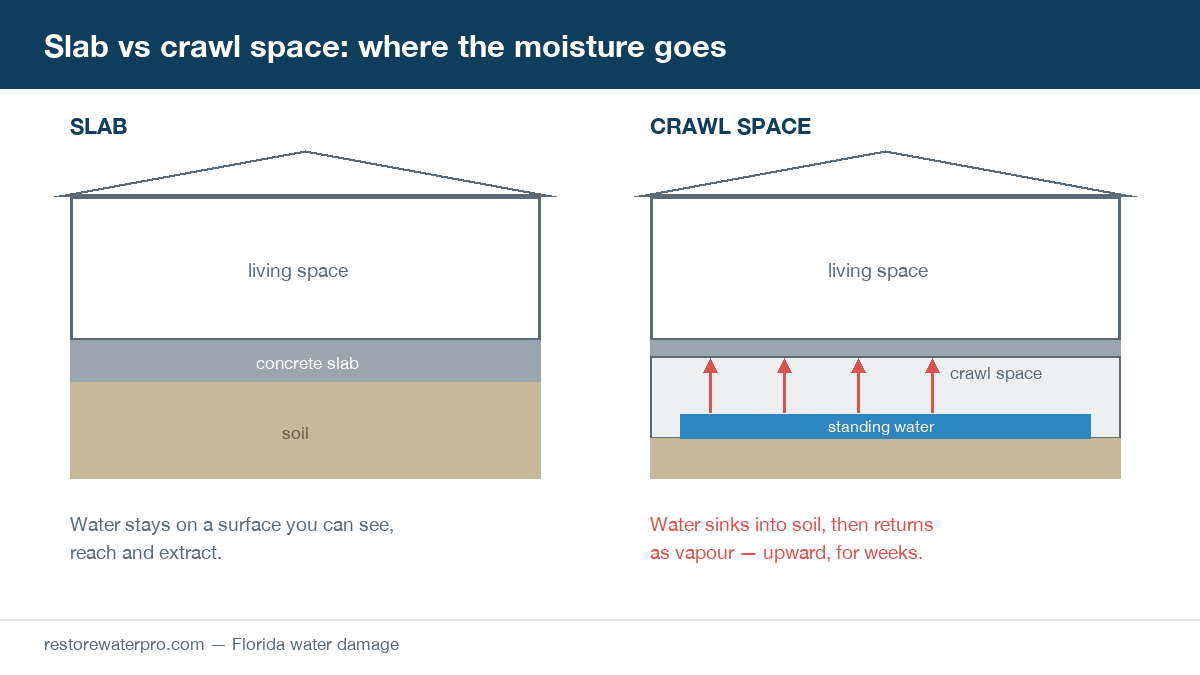
On a slab, water spreads across a hard surface you can see and reach. You extract it, you dry the flooring, and you deal with wicking into baseboards and drywall.
A crawl space has none of that. The floor is usually bare soil or a plastic vapour barrier laid over soil. Water that gets in has somewhere to go — down — which makes it look like the problem is solving itself. It is not. The soil holds the moisture and releases it slowly as vapour, and that vapour has only one direction to travel: up, through the subfloor, into the house.
That is the part homeowners underestimate. The visible water may be gone in a day. The moisture load can stay for weeks, and it is what feeds mould growth in the floor system, insulation, and ductwork.
The first two hours
The order matters more than the speed.
- Cut the power to the crawl space and to any circuit that runs through it before anyone goes near the opening. Crawl spaces carry wiring, and standing water plus energised cable is the one risk here that can kill.
- Find out where the water came from. A supply line under the floor, a failed water heater, groundwater rising through the soil, and sewage backing up are four different problems with four different responses. Guessing wrong wastes the first day.
- Do not go in if you cannot identify the source. Confined space, poor light, possible contamination. This is the point where calling someone with the right equipment is cheaper than the alternative.
- Open the vents and get air moving only if the outside air is drier than the air underneath. In a Florida August, it very often is not, and running a fan pulls humid air in and makes the drying worse.
That last point catches people out. Ventilation is not the same as drying. If the outdoor dew point is high, you are importing moisture, not removing it.
What not to do
Do not put down fresh plastic sheeting over wet soil. A vapour barrier laid on saturated ground traps the moisture underneath and gives you a slow-release humidifier under your floor.
Do not replace insulation until the framing is dry. Wet fibreglass batts held against a wet joist keep it wet. Pull the insulation out, dry the structure, then insulate.
Do not assume the smell will go once the water does. A musty odour in the rooms above after a crawl space event is usually the floor system telling you it is still wet.
When the water is not clean
Water is graded by what is in it, and the grade decides how the job is done. We cover this in more detail in our guide to clean, gray and black water categories, but the short version for a crawl space is this:
- A supply line break starts clean. Left in contact with soil, it does not stay clean for long.
- Groundwater rising through the soil is contaminated from the start. It has passed through ground that may carry fertiliser, septic discharge, or animal waste.
- A sewage backup in a crawl space is a containment and disposal job, not a cleanup. Materials that absorbed it come out.
If you are dealing with the third category, our page on sewage backup cleanup explains what the process actually involves.
Drying takes longer down there, and that is normal
A dried-out crawl space is not one that looks dry. It is one where the moisture content of the wood has come back down to what it was before, and soil that has absorbed water gives it back slowly.
Equipment matters here in a way it does not on a slab. Air movers alone move humid air around a closed space. What removes water is a dehumidifier sized for the volume, running long enough to pull the moisture out of the soil and the framing. Our explanation of what drying equipment actually does covers why the two are not interchangeable.
Expect the process to be measured, not guessed. Anyone drying a crawl space properly will be taking moisture readings in the joists and subfloor, not judging by feel.
Why the clock matters for mould
Mould does not wait for the structure to be convenient. Warm, wet, still air under a Florida house is close to ideal conditions, and a crawl space provides all three by default. Our page on the mould growth timeline after a water leak sets out the sequence.
The practical consequence: a crawl space that stays wet for a week is a different and more expensive job than the same crawl space dried in forty-eight hours.
Questions homeowners ask
The water drained away by itself. Am I fine?
Probably not. Water leaving the surface means it went into the soil, not out of the building. The moisture is still under your floor and still evaporating upward.
Can I just run a fan down there?
Only if the air you are bringing in is drier than the air already there. For much of the Florida year it is not, and a fan alone will slow the drying rather than speed it.
Will my insurance cover it?
That depends on the cause, not the location. A sudden pipe failure and gradual groundwater intrusion are treated very differently. Our page on whether insurance covers water damage goes through the distinctions, and there is a filing deadline in Florida you need to know about — see water damage insurance claims.
How do I know when it is actually dry?
By measurement. Moisture meter readings on the joists and subfloor, compared against a dry reference area of the same material in the same house.
Need someone under the house today?
If you have standing water in a crawl space, contaminated water of any kind, or a musty smell in the rooms above after a leak, the sooner someone gets equipment in place the smaller the job stays.
Request Help — water damage help across Florida, available around the clock.
Written by the RestoreWaterPro editorial team. Information on foundation types in Florida reflects general construction practice in the state; the right response for your home depends on what a technician finds on site. Last reviewed 31 August 2026.
Leave a Reply